
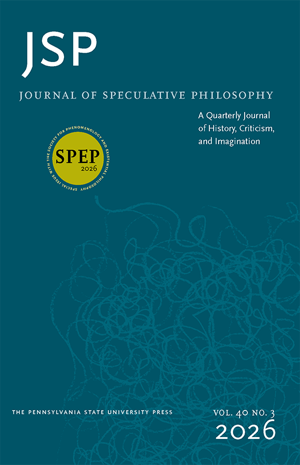
On July 7, 2026, the paper of Dr. Martina Properzi, a PhD candidate in the Doctoral School of Philosophy, was published in the new issue of the prestigious Journal of Speculative Philosophy (JSP, https://scholarlypublishingcollective.org/psup/speculative-philosophy) by Penn State University Press. The scope of JSP is to provide a platform for philosophical discussion from the Continental and American philosophy, novel trends in art, religion, and literature, as well as developments in the ideas and theories of past philosophers that have relevance for contemporary thinkers. Dr. Properzi’s paper is titled “The Normativity of Bodily Boundaries.” It inaugurates the session “Reflection on Bodily Normativity and Justice” in the special issue published in collaboration with the Society for Phenomenology and Existential Philosophy (SPEP). The issue is edited by Prof. Antonio Calcagno (King’s University College at Western University) and Prof. Shannon Mussett (Utah Valley University), and it contains contributions from world-leading scholars, such as Manuel De Landa and Sara Ahmed.
Dr. Properzi’s paper is available on the Scholarly Publishing Collective using the following link:
https://scholarlypublishingcollective.org/psup/speculative-philosophy/article/doi/10.5325/jspe cphil.40.3.0258/411459/The-Normativity-of-Bodily-Boundaries?guestAccessKey=e650fc29-c 6dc-4caa-bde6-a5deef53adf2.
Here is the paper’s abstract:
“This article explores the normative facet of bodily boundaries. By this, the article is referring to stabilizing and optimal standards that shape the self/other distinction in its basic spatial configuration. Despite differences in the foundational approach to normativity, the extant theoretical frameworks of normative empiricism and social constructivism share a common representationalist background. The norms of bodily boundaries are associated with mental representations of the body that exert prescriptive force on its lived liminality. Evidence from atypical forms of somatic consciousness suggests a mild version of antirepresentationalism that centralizes the motivational structure of the motor subject—rather than its simulative underpinnings in the mind/brain—and aligns with the key socioconstructivist idea of the social regulation of the boundary between “my” body and the external world. The article is to revisit social constructivism through a phenomenology of social affordance that emphasizes the motor subjectivity embedded in affording intersubjective interactions and shared pragmatical contexts in stabilizing and harmonizing the body space”.