
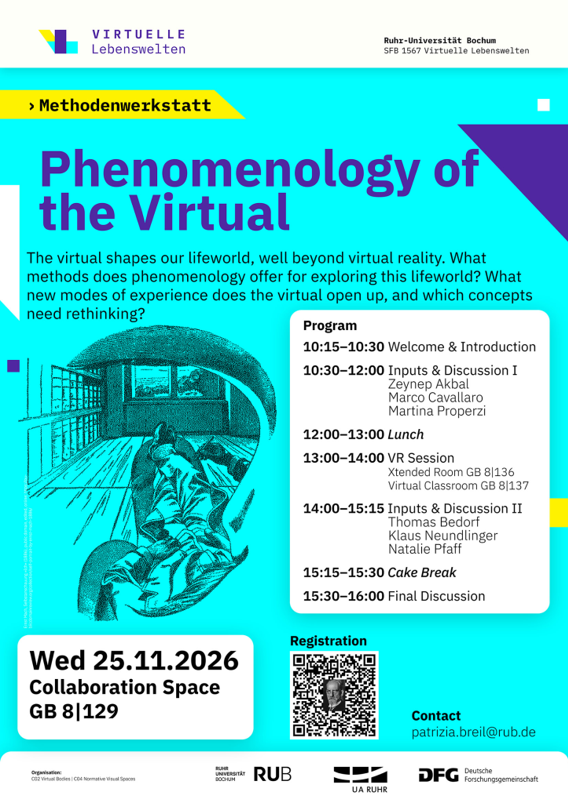
On November 25, 2026, Dr. Martina Properzi, a PhD candidate in the Doctoral School of Philosophy, will take part in the international event “Phenomenology of the Virtual” organized by Ruhr University Bochum in the context of the research action “Virtuelle Lebenswelten” (https://www.virtuelle-lebenswelten.de/blog-post/methodenwerkstatt-phenomenology-of-the-virtual-25-11-2026). Following input presentations by the speakers, the event will discuss how virtuality shapes our lifeworld and what phenomenological methods can reveal about these transformations. As part of the workshop, the SFB’s Xtended Room will also provide an opportunity to put these questions to the test in practice by engaging in first-person VR experiences. Dr. Properzi will explore the intriguing yet challenging topic of Neuro-Reality, a new form of technology-mediated reality characterized by the critical-level convergence of AI-empowered software and implantable nanometer-sized hardware (e.g., brain chips) within our cognitive and sociotechnical organizations.
Here is the paper’s abstract: In this input presentation, I will introduce the emerging concept of neuro-reality (N-R) as a new form of technology-mediated reality. Unlike virtual reality (VR) and augmented reality (AR), N-R does not appear to rely on information conveyed by the body’s periphery (Urban, 2017). Rather, it seems to be the byproduct of open- or closed-loop processes between the brain and an external application device (e.g., a computerized wheelchair or robotic limb). Electrodes and signal processors facilitate brain-computer communication by recording, processing, and translating brain signals into machine-readable ones. N-R can be used by neurotypical individuals for playful experiences (O’Hara, Sellen & Harper, 2011) and by people with paralysis, including those with complete or incomplete locked-in syndrome (van Balen, van Grunsven, IJsselsteijn et al., 2026). The most intriguing aspect of N-R is its alleged potential for direct brain-computer communication. The interface bypasses the body’s sensory and motor pathways to establish a direct link between the brain and an information-processing machine. This setup enables the transmission of information in a supposedly more efficient and streamlined way. This makes the body seem like a “communication bottleneck,” implying that it should be replaced by more efficient technology (see Serim, Spapé & Jacucci, 2024, for an overview). I believe there is much room for phenomenological exploration here. This is due not only to phenomenology’s subtle analysis of the lived body. It is also, and perhaps more importantly, due to the breadth and depth of its methodology. In my presentation, I will discuss the potential benefits of using phenomenological methods to study N-R in three critical domains. First, in the sociopolitical domain, I will offer a critical phenomenological analysis of power structures and prevalent narratives about N-R. Second, in the personal domain, I will offer a genetic phenomenological exploration of the mediating function of the body and technology. Finally, in the technical domain, I will demonstrate how phenomenological interviews can greatly support the implementation of a user-centered approach to designing and evaluating restorative N-R systems.